
STRATEGIC PLAN
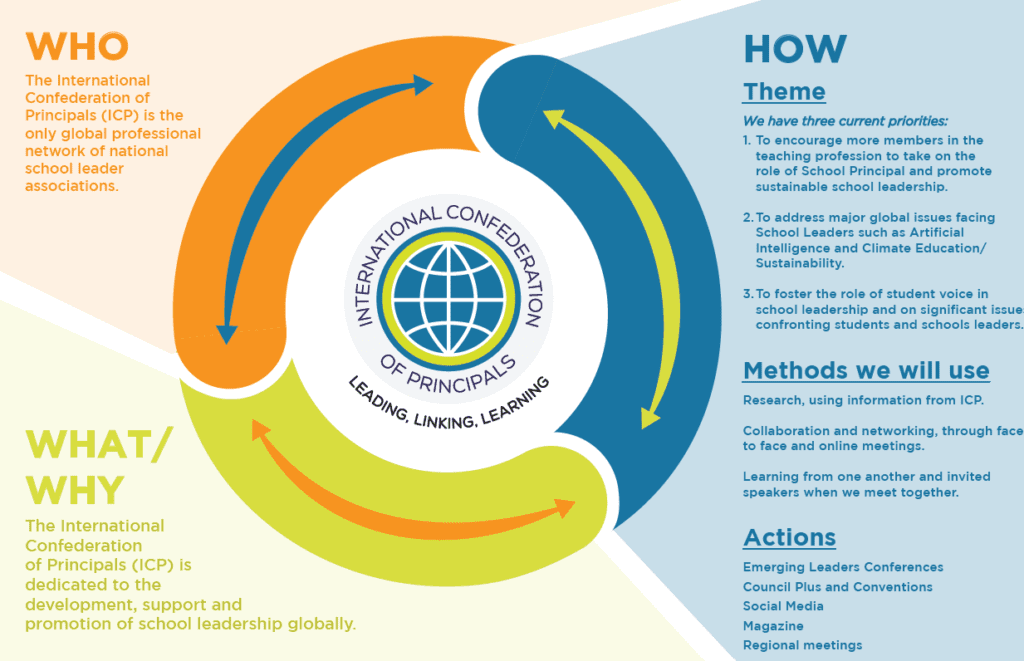
Summary of discussions and relation to the Strategic Plan
Suggestions to take the Strategic Plan further
- Business Model and Strategic Plan Development:
- Focus on ICP Sustainability: Emphasis on creating a business model to ensure ICP’s long-term viability. This includes seeking alternative financial support and possibly developing a business plan.
- Need for a Business Model: Reiterated importance of developing a business model with sponsors or business partners to enhance ICP’s financial resources.
- Strategic Business Plan: Importance of having a clear strategic business plan to strengthen ICP’s work and extend its influence, leveraging expertise within ICP.
- Importance of a Business Plan: Emphasized as a critical step for ICP’s growth, including financial projections, marketing strategies, and revenue generation.
- Shared Responsibility and Collective Action:
- Shared Responsibility for Strategic Plan Implementation: The council as a whole should support the executive in achieving strategic goals, leveraging collective knowledge and skills.
- Supporting the Executive with Specific Tasks: Executive members should lead specific priorities with support from member organizations that have expertise in those areas.
- Voluntary Contribution and Collective Action: Emphasized collective action where each organization contributes based on their expertise, leading to a more comprehensive and impactful outcome.
- Membership Expansion and Global Elevation:
- Expanding ICP’s Reach and Membership: Suggestion to develop strategies for expanding membership and providing reliable income to support the executive.
- Global Elevation of ICP: Importance of elevating ICP’s profile globally and making it a truly global organization recognized and respected worldwide.
- Increasing Awareness and Membership: Focus on increasing awareness of ICP among individual school principals, especially in regions where ICP is less well-known.
- Focus on Quality, Professionalism, and Networking:
- Professionalizing the Organization: Discussion about ICP becoming more businesslike to achieve goals effectively, potentially monetizing activities, and creating a more structured business model.
- Focus on Quality and Professionalism: Emphasized importance of presenting ICP as a professional and credible organization with high-quality materials and communications.
- Collaboration and Networking: Importance of collaboration between member organizations to share best practices and advance common goals, especially at global events.
- Reordering and Refining Strategic Priorities:
- Reordering Priorities: Suggested that the strategic plan should first focus on promoting sustainable school leadership, with encouragement of members to take on leadership roles following naturally.
- Split of Strategic Priorities: Suggestion to split the first strategic priority into two distinct tasks—sustainable leadership and promoting school leadership as a profession.
- Student Voice and Involvement:
- Role of Student Voice: Acknowledged the importance of student voice and potential to involve students more directly in council meetings.
- Focus on Student Voice: Highlighted as a strength in some systems, particularly where students are actively involved in leadership roles.
- Leveraging International Diversity:
- Leveraging International Diversity: Discussion on how ICP can facilitate networking and knowledge exchange between countries at different stages of educational development.
- Sharing Best Practices: Proposed creating an integrated database where members could share best practices, allowing for easier access to successful strategies and innovations.
- School Connect Program: Suggested introduction of a program where member schools could share best practices and learn from one another.
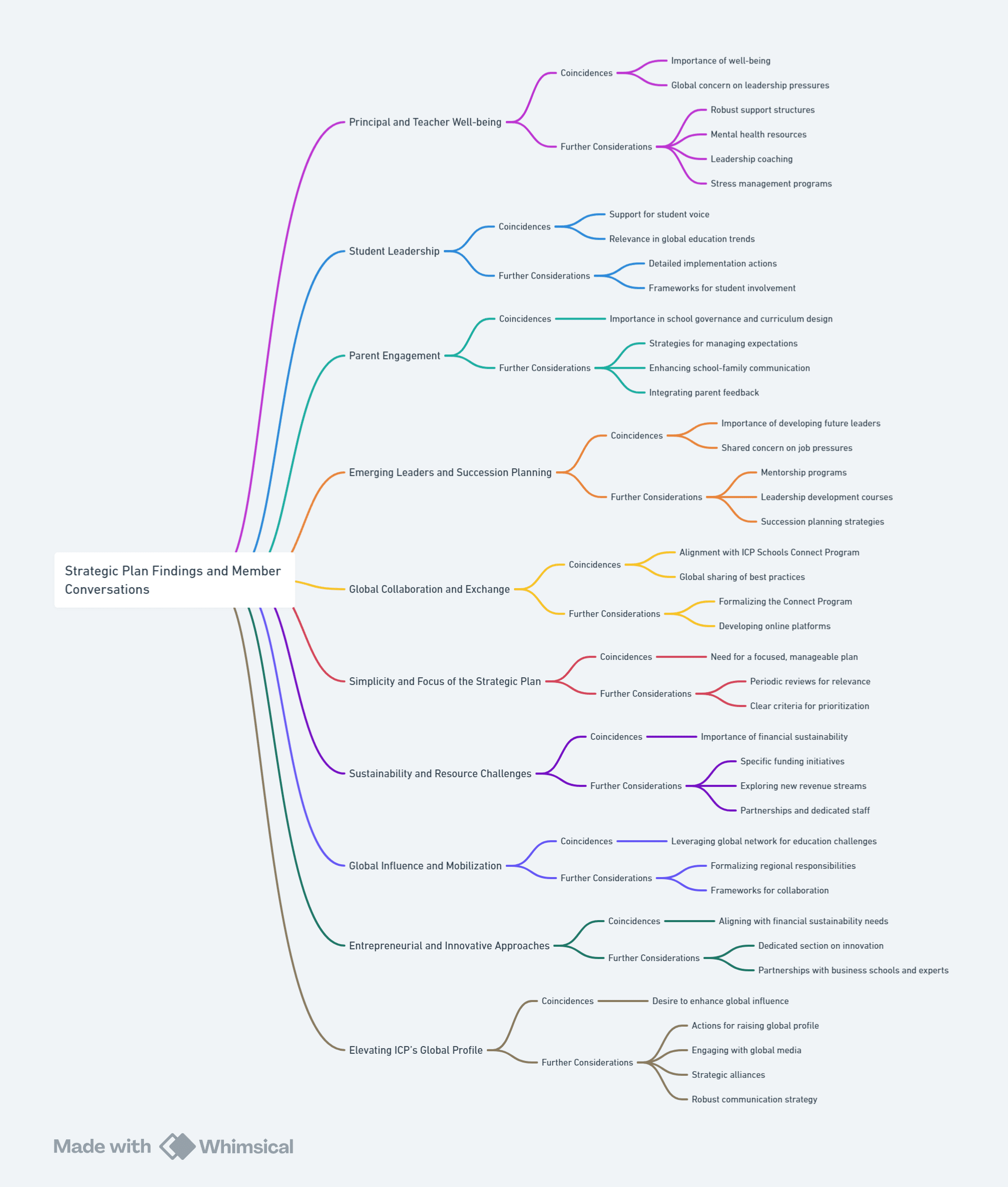
Strategic Plan Findings and Member Conversations
The conversations among ICP members and the analysis of the strategic plan reveal several overlapping themes and concerns that both support and challenge the current direction of ICP. The discussions provide insight into how the strategic priorities are perceived and where there may be opportunities for refinement or expansion. Below is a detailed synthesis of these findings, focusing on key areas of alignment and potential growth.
1. Principal and Teacher Well-being
- Coincidences: Both the strategic plan and member conversations emphasize the critical importance of principal and teacher well-being. The discussions reflect a global concern about the pressures faced by school leaders, particularly in maintaining sustainable leadership roles. This aligns with the strategic priority of promoting sustainable leadership, suggesting that ICP’s current focus is well-placed.
- Further Considerations: The conversations indicate a need for more robust support structures for principals to alleviate these pressures. This could lead to the development of specific initiatives within the strategic plan, such as mental health resources, leadership coaching, and stress management programs tailored for school leaders.
2. Student Leadership
- Coincidences: The emphasis on student leadership in the conversations strongly supports the strategic priority of fostering student voice in school leadership. The global trend towards student-centered education, particularly highlighted by the Chinese context, demonstrates that this priority is both timely and relevant across different educational systems.
- Further Considerations: To capitalize on this alignment, the strategic plan could include more detailed actions on how to implement and support student leadership initiatives globally. This might involve creating frameworks or resources that schools can adopt to enhance student involvement in decision-making processes.
3. Parent Engagement
- Coincidences: While parent engagement is not a primary focus of the strategic plan, the discussions underscore its importance, particularly in the context of school governance and curriculum design. The challenges of balancing parental involvement with professional judgment reflect broader issues that impact school leadership.
- Further Considerations: The strategic plan could be expanded to address the role of parents in school leadership more explicitly. This might include strategies for managing parent expectations, enhancing communication between schools and families, and integrating parent feedback into school policies in a way that supports the overall strategic goals.
4. Emerging Leaders and Succession Planning
- Coincidences: Both the strategic plan and member conversations recognize the importance of developing the next generation of school leaders. The reluctance of emerging leaders to take on principal roles due to job pressures is a shared concern, aligning with the priority of sustainable leadership.
- Further Considerations: The strategic plan could benefit from more targeted initiatives aimed at emerging leaders, such as mentorship programs, leadership development courses, and succession planning strategies. These could help to ensure a steady pipeline of capable leaders ready to step into principal roles.
5. Global Collaboration and Exchange
- Coincidences: The idea of a structured ICP Schools Connect Program aligns with the strategic priority of fostering collaboration and networking. The global nature of ICP’s membership provides a unique opportunity to share best practices and collaborate on common challenges, which is supported by the strategic plan.
- Further Considerations: To strengthen this alignment, the strategic plan could formalize the ICP Schools Connect Program, providing clear guidelines and resources for schools to engage in international partnerships. This could also include the development of online platforms for sharing knowledge and experiences among member schools.
6. Simplicity and Focus of the Strategic Plan
- Coincidences: There is a shared understanding among members that the strategic plan should remain focused and manageable, avoiding overcommitment to too many global issues. This aligns with the plan’s intent to address specific, impactful challenges rather than trying to solve every global problem.
- Further Considerations: To maintain this focus, the strategic plan might benefit from periodic reviews to ensure it remains relevant and adaptable to emerging global issues. This could involve setting clear criteria for selecting which global challenges to prioritize based on ICP’s capacity and resources.
7. Sustainability and Resource Challenges
- Coincidences: The discussions around the need for financial sustainability and resource development are critical to the long-term success of ICP. This is recognized as a fundamental aspect of the strategic plan, although it may require more explicit goals and actions.
- Further Considerations: The strategic plan could include specific initiatives to secure funding, such as developing business models, exploring new revenue streams, and forming partnerships with global organizations. Additionally, employing dedicated staff to manage these efforts could be a key step towards achieving sustainability.
8. Global Influence and Mobilization
- Coincidences: Leveraging ICP’s global network to address educational challenges is a shared goal between the strategic plan and member conversations. The idea of mobilizing regional groups within ICP to take on specific initiatives could enhance the organization’s global influence.
- Further Considerations: The strategic plan could formalize this approach by delegating specific responsibilities to regional groups and creating frameworks for collaboration. This would not only enhance ICP’s global reach but also ensure that local expertise is utilized effectively.
9. Entrepreneurial and Innovative Approaches
- Coincidences: Adopting innovative business models to sustain ICP’s operations aligns with the need for financial sustainability. The strategic plan should explore these approaches further, potentially drawing on examples from other sectors.
- Further Considerations: The strategic plan could include a dedicated section on innovation, outlining steps for researching and implementing new business models. This could involve partnerships with business schools, financial experts, or other organizations experienced in innovative funding strategies.
10. Elevating ICP’s Global Profile
- Coincidences: The desire to position ICP as a respected global voice in education is a recurring theme in both the strategic plan and member conversations. Enhancing ICP’s visibility and influence is seen as critical to its success.
- Further Considerations: The strategic plan could prioritize actions aimed at raising ICP’s profile, such as engaging with global media, participating in international forums, and forming strategic alliances with other global organizations. A robust communication strategy could be developed to ensure that ICP’s voice is heard on key global educational issues.
Overall Analysis
The alignment between the strategic plan and member conversations indicates that ICP is on the right track with its current priorities. However, there are clear opportunities for refining and expanding the plan to better address the challenges and opportunities discussed by members. By integrating more focused initiatives on well-being, sustainability, global collaboration, and innovation, ICP can strengthen its strategic impact and continue to grow as a leading global force in education.