

Click here to return to the Convention Page
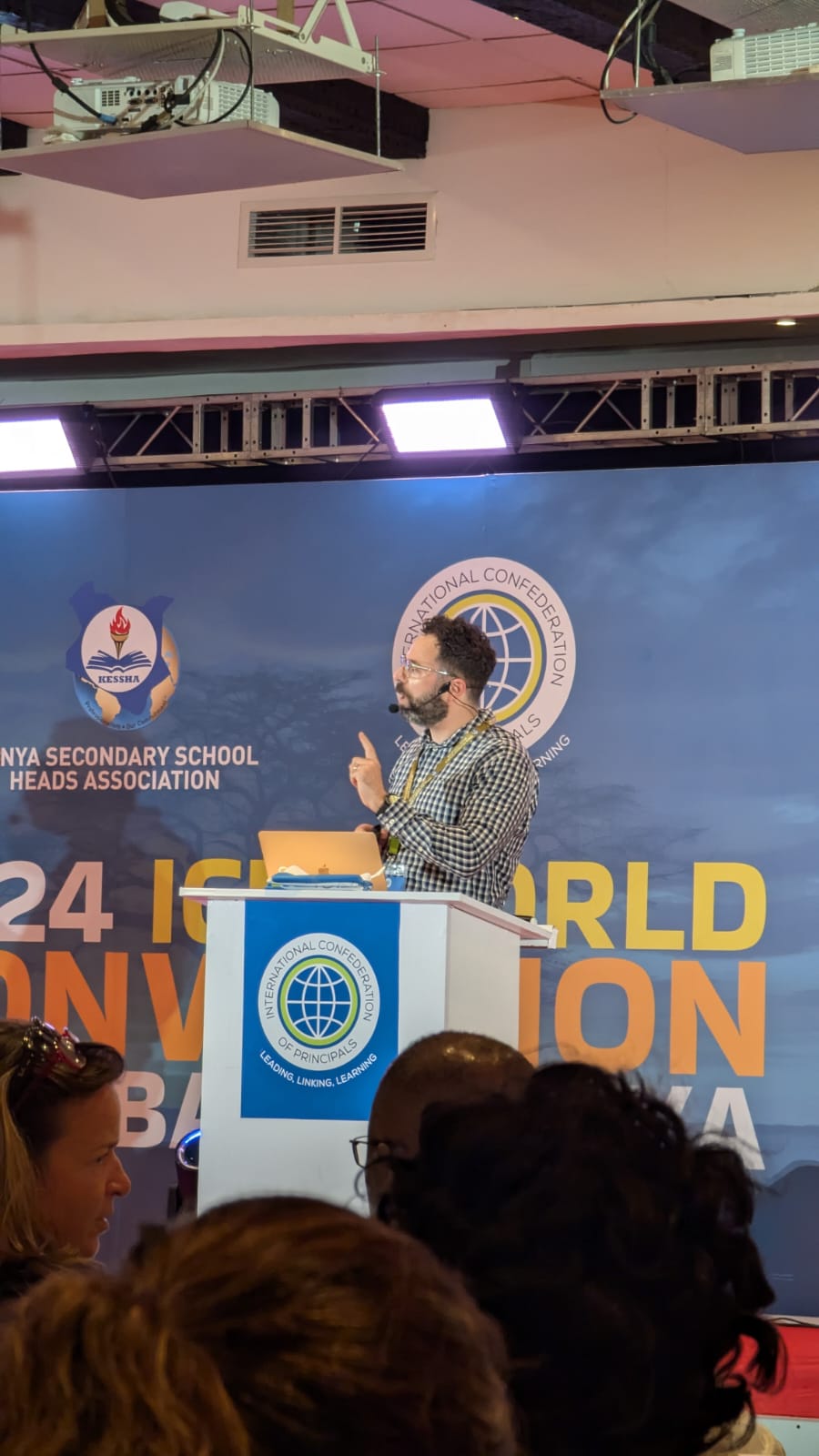
Plenary Keynote 8 – Reimagining Education: How Ruckus
Makers Do School Different
The Impact of the UN Global Innovation Hub
Danny Bauer
Better Leaders Better Schools
- Opening Remarks and Engagement
- Starting the Session:
- Danny Bauer began by engaging the audience with a series of questions to gauge their interest in exploring new pathways for education and making a greater impact.
- He acknowledged the audience as high achievers for wanting both, and reassured them that they were in the right place for such discussions.
- Bauer humorously noted that he had 55 minutes to speak but gained an extra two minutes by forgetting to start his stopwatch, showing his relaxed and personable approach.
- Acknowledging the Audience:
- Bauer asked the audience to congratulate each other for their commitment to being present and investing in their personal and professional development.
- He encouraged them to turn to a neighbor, give a high five, and express gratitude for being there, fostering a sense of community and participation from the start.
- Personal Introduction
- Background and Experience:
- Bauer introduced himself, mentioning that his name is Danny and that he would be sharing his best ideas during the session.
- He shared his varied background, having lived in different states in the U.S. (Illinois, New York, Texas, Georgia) and in Europe (Belgium, the Netherlands, Scotland).
- Currently residing in Syracuse, New York, he humorously invited the audience to visit his home, displaying an image of his house to emphasize his approachable nature.
- Professional Achievements:
- Bauer highlighted his work as the founder of “Better Leaders, Better Schools,” a company he started in 2015.
- He mentioned his focus on the concept of “Ruckus Makers,” educators who approach school differently, emphasizing the importance of language and simplicity in leadership.
- Bauer shared that he is a three-time bestselling author, with books on creating a three-year vision for schools, developing entry plans, and applying ancient Stoic philosophy to modern leadership challenges.
- The Power of Podcasts and Self-Development
- Personal Leadership Journey:
- Bauer explained how starting the “Better Leaders, Better Schools” podcast was a turning point in his leadership journey.
- He created the podcast to address a gap in his leadership, seeking to learn from other leaders around the world by asking them what made them successful.
- By taking action on the ideas shared by his podcast guests, Bauer transformed his leadership style and opened new opportunities, leading him to speak at events like this one.
- The Importance of Radical Accountability:
- Bauer emphasized the concept of radical accountability, encouraging leaders to take control of their development rather than succumbing to self-pity.
- He shared his belief that leadership is about ownership and taking proactive steps to improve oneself, which in turn leads to better outcomes in school leadership.
- Rules for the Session
- Rule #1: Don’t Believe a Word I Say:
- Bauer encouraged critical thinking by asking the audience not to blindly believe everything he says.
- He explained that while his ideas have worked for many leaders, every school context is different, so participants should test these ideas and keep only what works for them.
- Rule #2: Ask a Lot of Questions:
- Bauer explained that he asks a lot of questions to engage participants and help them think more deeply.
- He believes that the answers to many leadership challenges are already within the leaders themselves, and his questions are meant to draw out those insights.
- Rule #3: Have Fun:
- Bauer stressed the importance of having fun during the session, creating an enjoyable and interactive environment for learning.
- He aimed to make the session engaging and memorable, encouraging participants to fully participate in the discussions.
- The Challenge of Traditional Education
- Critique of the Industrial Model:
- Bauer critiqued the traditional industrial model of education, describing it as outdated and focused on producing compliant students rather than creative thinkers.
- He noted that this model leads to a “factory-like” approach to education, where students are expected to follow rules and achieve grades without fostering innovation or individuality.
- Opportunity Within Challenges:
- Bauer framed challenges as opportunities for innovation, suggesting that obstacles in education are pathways to finding better solutions.
- He emphasized that leadership is about guiding people from the current reality to a more prosperous future, and that student voice and agency are crucial in this journey.
- Examples of Innovative Leaders
- Steve Jobs:
- Bauer shared the story of Steve Jobs, who returned to Apple when it was two months away from bankruptcy and transformed it into the first trillion-dollar company.
- Jobs’ success was attributed to simplifying the product line and focusing on innovation, demonstrating the power of keeping things simple.
- Elon Musk:
- Bauer discussed Elon Musk’s “secret plan” for Tesla, which involved building a sports car, using the profits to build an affordable car, and eventually providing zero-emission electric power generation options.
- He admired Musk’s ability to communicate a simple, clear plan and encouraged leaders to develop their own “secret plans” that are easy to communicate and execute.
- Simone Biles:
- Bauer praised Simone Biles for her five signature moves in gymnastics and her decision to take a break for her mental health during the Olympics.
- He highlighted the importance of self-care, noting that leaders cannot pour from an empty cup and must take care of themselves to be effective.
- The Importance of Simplicity in Leadership
- Simplicity as a Key to Success:
- Bauer argued that simplicity is crucial in leadership, as it allows for faster and more effective change.
- He encouraged leaders to strip away unnecessary complexities and focus on the most straightforward paths to achieving their goals.
- The Concept of Simplicity as Velocity:
- Bauer introduced the idea that “simplicity is velocity,” meaning that keeping things simple allows leaders to move faster and make more significant progress.
- He suggested that leaders should constantly ask themselves how they can simplify their processes and decisions to achieve better results.
- Rejecting Common Educational Premises
- Challenging Traditional Beliefs:
- Bauer encouraged leaders to reject commonly held beliefs in education that no longer serve them, such as the notion that change is hard or that leaders must work long hours to be effective.
- He argued that these beliefs are rooted in outdated models and that true innovation comes from questioning and rejecting such premises.
- Ruckus Makers vs. Play-It-Safe Principals:
- Bauer contrasted two types of leaders:
- Play-It-Safe Principals: These leaders maintain the status quo and make only incremental changes, focusing on improving what already exists.
- Ruckus Makers: These leaders aim for exponential improvement, reject outdated premises, and are committed to creating a radically better future.
- Bauer contrasted two types of leaders:
- Overcoming Challenges in Education
- Using “Can-If” Statements:
- Bauer shared a strategy for overcoming challenges by using “can-if” statements, which reframe problems as opportunities for creative solutions.
- He provided examples from companies like Airbnb and Uber, which succeeded by leveraging existing resources in innovative ways.
- Adapting and Innovating:
- Bauer encouraged leaders to think of innovative ways to adapt to challenges, such as using downtime in classrooms to teach additional skills or rethinking traditional educational practices.
- The Role of AI in Education
- Importance of AI Skills:
- Bauer discussed the growing importance of AI skills in the workforce, citing a study by LinkedIn and Microsoft that found 66% of business leaders prioritize hiring candidates with AI skills.
- He emphasized the need for educators to prepare students for a future where AI skills are essential, and highlighted the work of Hannah Grady-Williams, who partners with schools to provide AI-focused internships.
- Final Thoughts and Guided Visualization
- Guided Visualization Exercise:
- Bauer concluded the session with a guided visualization exercise, asking participants to think about a shift they want to make on their campuses.
- He encouraged them to imagine their schools fully resourced and supported, and to consider how they could make a significant impact without fear of failure.
- Reflection and Action:
- Bauer urged participants to hold onto the ideas they visualized and to take action on them, reminding them that there is no such thing as failure, only learning.
- He encouraged leaders to keep their vision simple and focused, and to pursue it with determination and creativity.